Education
What Are Staking Rewards and How Are They Calculated?
If you've heard that you can "earn rewards" on certain cryptocurrencies just by holding them, you're hearing about staking rewards. But how does that actually work? Who pays the rewards? And how do you know what rate you'll earn? This guide answers all of that in plain language.
What Are Staking Rewards? (The Simple Version)
Staking rewards are the payments you receive for helping a blockchain network operate securely by committing, or staking, your cryptocurrency. They are the proof of stake equivalent of what miners earn in proof of work systems like Bitcoin. Instead of using large amounts of electricity to compete for rewards, you commit your own assets to help validate the network.
Every blockchain needs participants to verify transactions and maintain the integrity of its ledger. In proof of stake systems, staking provides that participation. In return for helping secure the network, you are rewarded in the same cryptocurrency that you staked.
If you’re interested in learning more about crypto staking and how this works on the Solana network, see here.
Where Do the Rewards Come From?
Staking rewards generally come from two primary sources, depending on how the network is designed.
The first source is new token issuance. Most proof-of-stake networks periodically create a small amount of new tokens and distribute them to participants who are staking. This functions as an incentive mechanism to secure the network and compensate validators and delegators for their role in maintaining it.
The second source is transaction fees. Whenever users send tokens, interact with applications, or trade assets on the network, they pay small fees. A portion of those fees is distributed to validators and, in many cases, shared with stakers who have delegated their tokens to those validators.
On Solana, staking rewards primarily consist of newly issued SOL along with a share of transaction fees. On Ethereum, validators earn newly issued ETH as well as a portion of priority fees paid by users to have their transactions processed more quickly.
How Is the Staking Rate Calculated?
The annual staking yield, often referred to as staking reward rate, is influenced by several key variables.
The total amount staked across the entire Solana network is typically the most important factor. If 50% of all SOL is staked, the available rewards are distributed among that group. If 70% is staked, the same overall reward pool is divided among more participants, resulting in a lower individual yield. In general, as more people stake, the reward rate per person declines, and when fewer people stake, the rate increases.
The network issuance rate also plays a central role. Each blockchain follows a programmed schedule that determines how much new cryptocurrency is issued each year. Solana’s issuance rate declines over time according to its inflation schedule, which means staking yields are designed to gradually decrease as the network matures.
Network activity affects rewards as well. When usage is high and users are paying more transaction fees, validators and stakers earn more from fee revenue. When activity slows, the portion of rewards derived from fees decreases.
Validator performance is another important variable. If the validator you delegate to maintain strong uptime and reliable performance, you receive the full expected rewards. If that validator frequently goes offline or performs poorly, your staking rewards can be reduced.
To see current staking rates across major proof of stake networks, visit https://solanabeach.io/
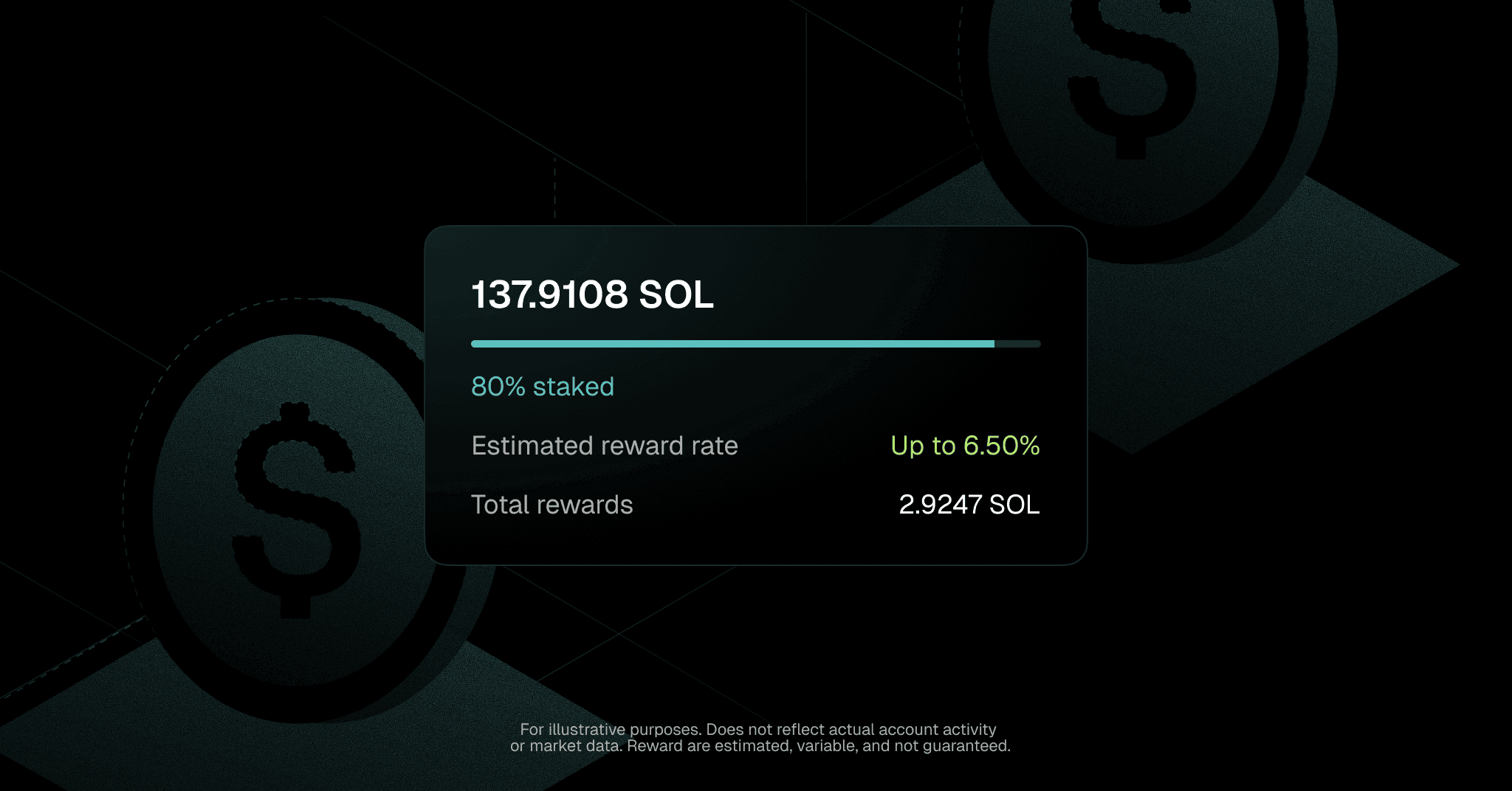
On GalaxyOne Staking, you can earn up to an estimated 6.50% in variable staking rewards on your SOL with a minimum of 1 SOL required to stake on the platform. Additionally, GalaxyOne will not charge a platform commission fee on staking rewards earned now through December 31, 2026. Other fees may apply, see terms.
Read more about our GalaxyOne Product Announcement here.
A Simple Example
Assume you stake 100 SOL at a hypothetical 6.50% staking rewards rate.
After 12 months, you could earn approximately 6.5 SOL in staking rewards if the variable reward rate stayed consistent and network conditions remained stable. Instead of holding 100 SOL, you would now have 106.5 SOL.
If SOL is priced at $85 when you begin and still $85 at the end of the year, your hypothetical total value increases from $8,500 to about $9,052. That represents a gain of $552 purely from staking rewards, even though the market price did not change.
Now imagine SOL rises to $150. Your 106.5 SOL would be worth $15,975. If you had not staked and still held only 100 SOL, your holdings would be worth $15,000. In this scenario, staking adds an extra $975 on top of the price appreciation.
These examples illustrate how staking may impact total token holdings over time. These hypothetical scenarios are for illustrative purposes only, do not represent actual projected or expected outcomes, and should not be interpreted as a guarantee of future performance or as investment advice.
Staking Rewards vs. Other Types of Yield
Staking rewards are one of several ways to earn yield in digital assets, and they differ meaningfully from other approaches.
Staking rewards are earned by helping secure a proof of stake blockchain, with compensation coming directly from the protocol itself. This makes staking relatively straightforward and potentially less risky compared with more complex crypto yield strategies.
By contrast, DeFi yield farming involves depositing assets into liquidity pools or decentralized applications to generate returns. While potential rewards can be higher, the strategy is more complex and introduces additional risks, including smart contract vulnerabilities and sharp market swings. Read more about where investors can find yield in the market.
Because staking rewards are generated by the network protocol rather than relying primarily on third party borrowers or active trading strategies, staking is often viewed as a more straightforward and structurally lower risk form of crypto yield.
The Main Takeaway
Staking rewards are how proof-of-stake blockchains compensate participants for helping keep the network secure and operational. The rate you earn is variable and depends on several factors, including the total amount staked across the network, overall network activity, the protocol’s issuance schedule, and the performance of your chosen validator.
For long term holders of assets such as SOL or ETH, staking is a primary way to put those holdings to work, generating yield while maintaining exposure to the asset’s potential price appreciation.
Frequently Asked Questions
Are staking rewards guaranteed?
No. Staking reward rates are not fixed and can change over time. They fluctuate based on factors such as how many tokens are being staked, overall network activity, the protocol’s issuance schedule, and validator performance. The rates discussed earlier are current estimates, not guaranteed returns.
Do I pay taxes on staking rewards?
In the United States, staking rewards are generally treated by the IRS as ordinary income at the time they are received. The taxable amount is typically based on the fair market value of the token at the time you gain control of it. Because tax treatment can vary by jurisdiction and individual circumstances, it is important to consult a qualified tax advisor.
Can staking rewards compound?
Yes, on most proof of stake networks, rewards can compound, meaning you can earn additional rewards on top of those rewards. This compounding effect can meaningfully increase total rewards over time. Some liquid staking protocols and certain ETF structures may handle this process automatically.
*Reward rate is estimated, variable, and not guaranteed. Rewards are variable and may increase or decrease. Actual returns depend on network conditions. Past performance is not indicative of future results. No platform commission through December 31, 2026. Platform commission is defined as the fee GalaxyOne charges to access staking on GalaxyOne and applies to Inflation and eligible MEV rewards earned while assets remain actively staked. Validators may retain transaction fees and certain protocol-level rewards associated with block production. Residual MEV rewards that are distributed after your assets are unstaked will not be credited to your account. Network transaction fees for sending and receiving SOL still apply.
This content is for informational purposes only and is not investment advice or a recommendation to buy or sell bitcoin or any security.
More Insights:
