Research & Insights
Make Yield Work Harder: Preserving Purchasing Power in an Inflationary World

In 1971, the U.S. stepped off the gold standard and entered a fully fiat era. Without gold as an anchor, the Federal Reserve has had more freedom to adjust rates and expand the supply of dollars making it easier to support the economy, but also easier to dilute an individual’s purchasing power. The flexibility has benefits, supporting growth in downturns; however, it also means the supply of money can expand faster than goods and services. Over long cycles, that dynamic shows up as inflation in consumer prices and, more broadly, as currency debasement: a gradual dilution of purchasing power for U.S. individuals and households holding dollars.
Traditional savings accounts offered by brick-and-mortar banks typically prioritize convenience over competitive rates, leaving cash balances growing slowly. High-yield cash accounts (HYCAs) offered by fintechs and neo-banks improve the picture, often making cash feel productive again. But headline APY is not the same as “real” return. If the cost of living and the stock of money rise faster than your interest rate, purchasing power still erodes. The core challenge isn’t just earning interest on one’s dollars; it’s defending real value over time.
This is where scarce digital assets enter the conversation. Bitcoin’s supply is capped at 21 million with a predictable issuance schedule, and other crypto assets feature programmatic constraints or utility-based demand. While prices are volatile and outcomes are not guaranteed, these properties give crypto the potential to act as a partial hedge against monetary expansion, similar in spirit to gold’s role under a fiat regime, but with distinctly digital mechanics and liquidity. The key is sizing exposure in a way that recognizes both the hedge potential and the volatility.
One practical approach is to separate principal from yield. Keep core cash in a high-yield cash account for stability and liquidity, and funnel the monthly interest, the risk budget generated by cash, into bitcoin or another supported asset on a systematic schedule. GalaxyOne’s high-yield cash account pays 3.75% Annual Percentage Yield (APY)* and can auto-invest the interest directly into crypto on platform**, so the conversion happens without manual transfers. This turns a nominal yield into a steady claim on scarcity and aims to offset inflation and debasement over time without touching principal. To test the idea, we compare two paths for investing $2,500 each month: keep everything in a high-yield cash account and reinvest the interest back into cash or keep principal in the high-yield cash account and convert each month’s interest into bitcoin. We judge both by purchasing power rather than headline yield, with results viewed through consumer prices and broad money supply.
Measuring Real Value: Bitcoin vs. Inflation and Money Supply
In the following charts we look at purchasing power through two lenses. The consumer price index (CPI) converts balances into “real” dollars by adjusting for rising consumer prices, while the Federal Reserve’s M2 is a broad measure of money-supply that reflects how the stock of money changes over time. Over the last five years, both CPI and M2 rose, so an individual investor who simply compounded interest in cash may have experienced part of their nominal gains eroded by higher prices and by money-supply growth.
The adjustments are applied consistently to both strategies. Each month’s portfolio value is calculated, then divided by the CPI index and, in a separate view, by an M2 index. Only the cash principal is adjusted by CPI and M2 in both paths. The bitcoin balance is not adjusted for inflation, which highlights that while dollars lose purchasing power under inflation, bitcoin’s supply remains fixed and predictable, though its market value can fluctuate significantly.

Based on the hypothetical illustration, adjusting for inflation increased the difference between reinvesting into BTC and reinvesting in a 3.75% high-yield cash deposit account. High-yield cash account returns are fixed in nominal dollars, and high inflation compresses its real return, while BTC’s price appreciation over the period more than kept up with CPI. As a result, inflation reduced the real return of a fixed HYCA rate, while bitcoin’s gains in this window outpaced that inflation, so the BTC strategy looks even better once adjusted for CPI over this period.
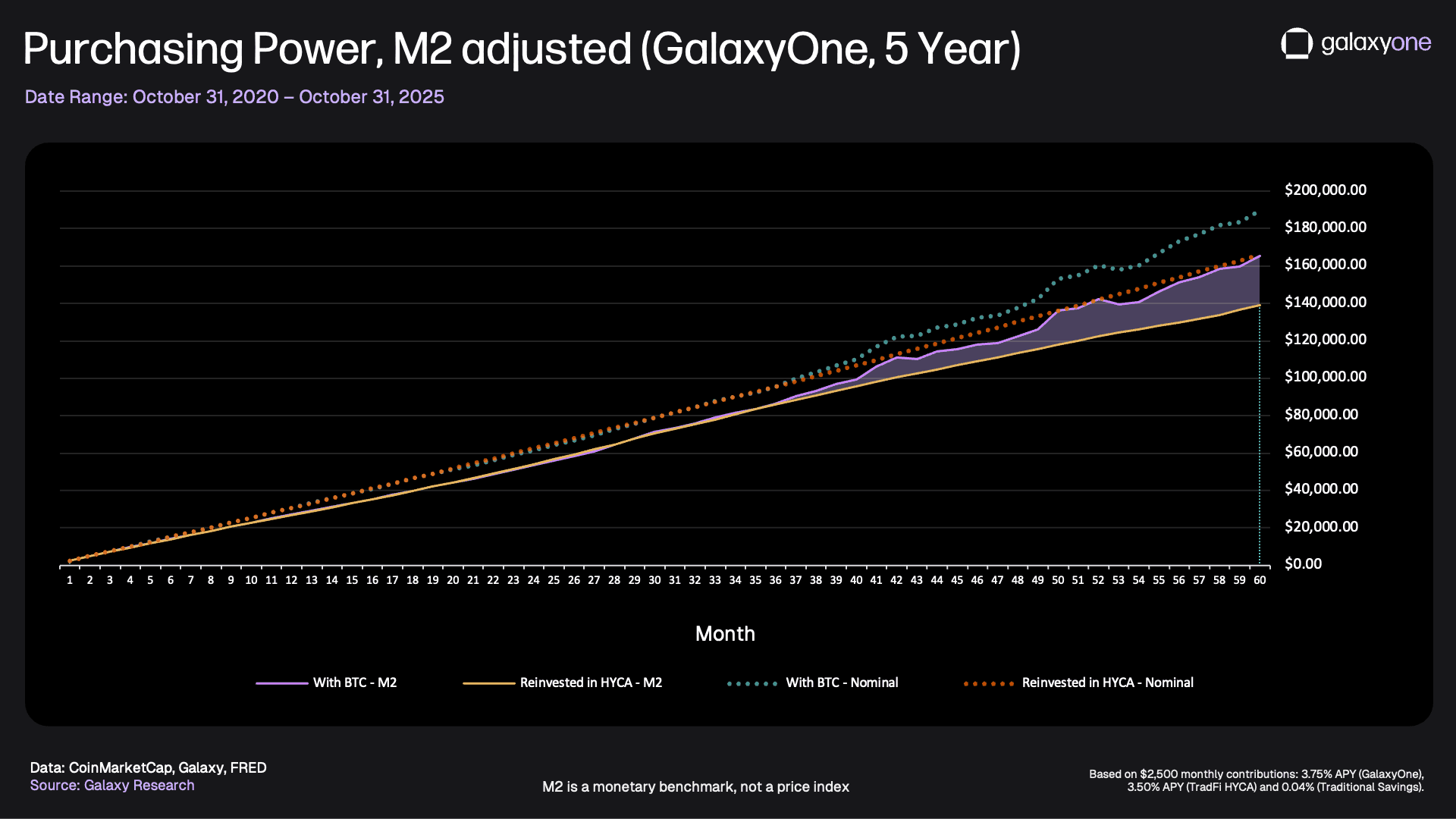
Adjusting by M2 results in a wider gap. During much of the sample, broad money supply grew faster than 3.75%, so a 3.75% high-yield cash account lagged when adjusted for M2. In M2 terms the cash track earns roughly 3.75% minus M2 growth, which was often negative, while the BTC track benefited from the same liquidity expansion and a fixed supply. The result is an M2-adjusted spread that is larger than both the nominal and CPI-adjusted gaps.
Adjusted for CPI and M2, the bitcoin path maintains purchasing power during the period, while a 3.75% high-yield account that compounds only in cash falls behind both inflation (CPI) and money-supply growth (M2).
GalaxyOne: Automate an Inflation and Debasement Defense
Based on the hypothetical illustrations, across five years, converting monthly high-yield cash account interest into bitcoin would have improved overall hypothetical account value and purchasing power versus simply reinvesting interest back into cash for a traditional compound investment strategy.
GalaxyOne makes this strategy practical. Interest can be auto-invested directly into bitcoin or another supported asset on platform, with no manual transfers or extra steps, and clear tracking with an option to change the reinvestment strategy month to month. For modern investors who want to keep their base cash position, GalaxyOne’s automation turns accrued interest from a high-yield cash deposit account into an automatic crypto allocation designed to automate diversification and provide exposure to digital assets.
Learn more about the GalaxyOne Cash account and open an account today in less than five minutes.
Disclaimers
GalaxyOne Cash account deposits held at Cross River Bank, Member FDIC. Insured up to $250,000. Debit Card issued by Cross River Bank, Member FDIC.
APY is variable and may change at any time before or after account opening.
Digital assets are highly volatile, not legal tender, and not backed by any government. Investments in cryptoassets involve significant risk, including the potential loss of all principal. Digital assets available on GalaxyOne are held in custodial wallets with Paxos Trust Company, a New York State-chartered trust company regulated by the New York Department of Financial Services. These assets are not insured by the FDIC or SIPC.
Crypto trading on GalaxyOne may be subject to execution, network, or withdrawal fees, including applicable blockchain transaction ("gas") fees. While GalaxyOne does not charge spread markups, other costs may apply. Crypto transactions may trigger taxable events; please consult your tax advisor to understand your individual tax obligations.
GalaxyOne’s crypto services are offered in partnership with Paxos. By using these services, you agree to the GalaxyOne Digital Asset Customer Agreement and Risk Disclosure, available at Paxos Customer Agreement.
The performance information presented is hypothetical and provided for illustrative purposes only. It does not represent actual trading results or the performance of any GalaxyOne account. The results are based on assumptions that may not reflect actual market conditions. Hypothetical performance is limiting, and should not be viewed as a guarantee of future performance or as investment advice. Past performance is not indicative of future results.
For educational purposes only; not a recommendation or solicitation
